A knowledge assistant
with a conscience
It reasons over your own documents and gives you answers you can trace, check and verify — built to help people, and to know when to get out of the way.
Most technology asks how to get people to use it more. We built Ethos Lite around a different question — how to genuinely help people, and know when to step back.
A system built for engagement counts the person who returns every day as a win. Ethos Lite counts the person who no longer needs it.
A conversation that's meant to end
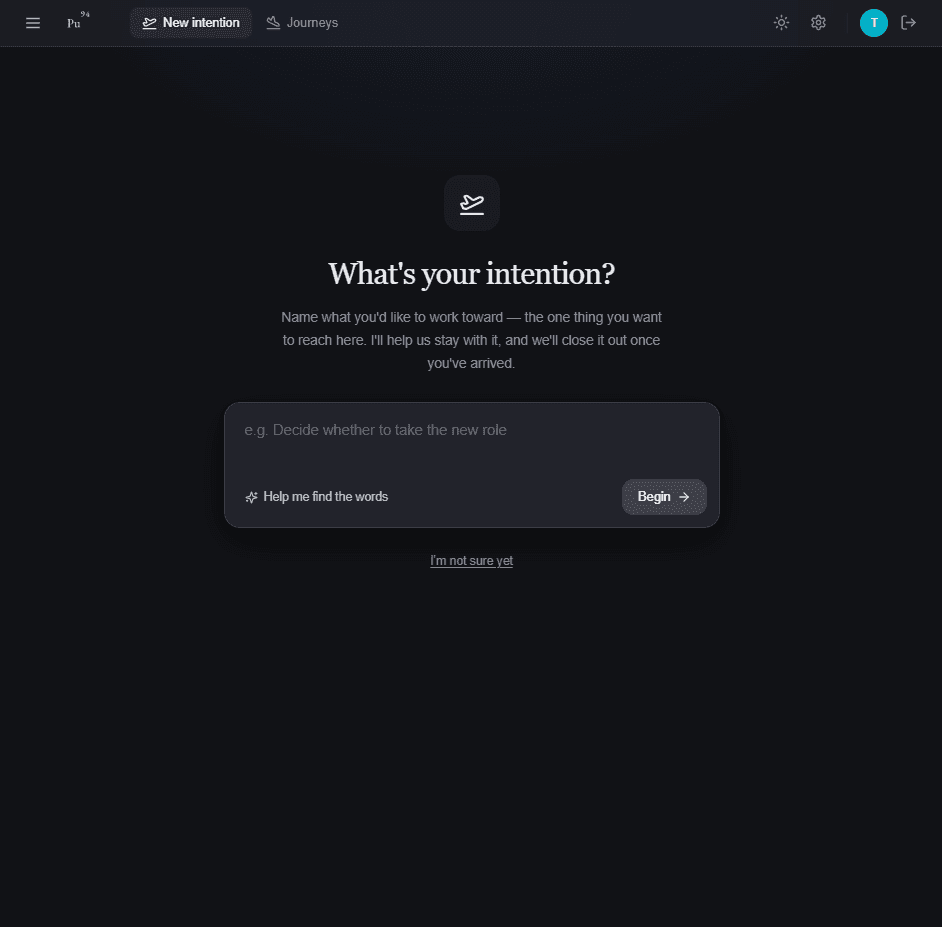
Every conversation here is a journey toward one intention — named by you, out loud, before anything else. There is no endless thread to fall into: you say where you're going, it helps you get there, and when you arrive, it ends.
A quiet signal notices when you've reached what you named and gently asks whether you've arrived. And if you can't find the words for your intention yet, a guided step helps you discover them.
When you land, you can carry something away — a written account of what you worked through, generated only if you ask for it. You leave with something, instead of being kept.
Ask your documents anything — or simply think out loud.
Technology in service of people
Traceable by design
It tells you where every answer came from, when it is inferring rather than citing, and when it simply does not know.
Your data, actually yours
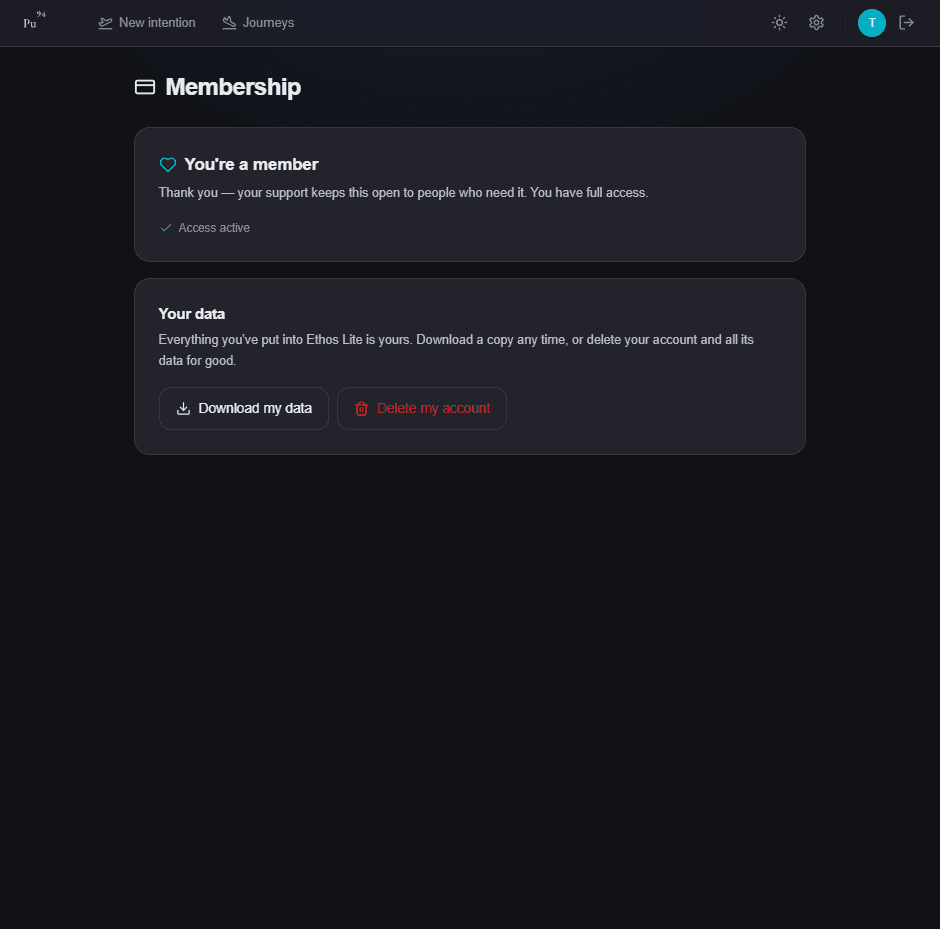
A personal map you can see and correct, a full export you can download at any moment, and a delete that removes your account and every trace of you — for good.
It meets you in your language
Ten languages, including Arabic and Urdu written right to left, with a voice that can speak its answers. It adapts to how you think — not the other way round.
No engagement tricks
No notifications to pull you back, no manufactured warmth, no rewards for dependency. It wants nothing from you except to be useful.
It accompanies a person, not a query
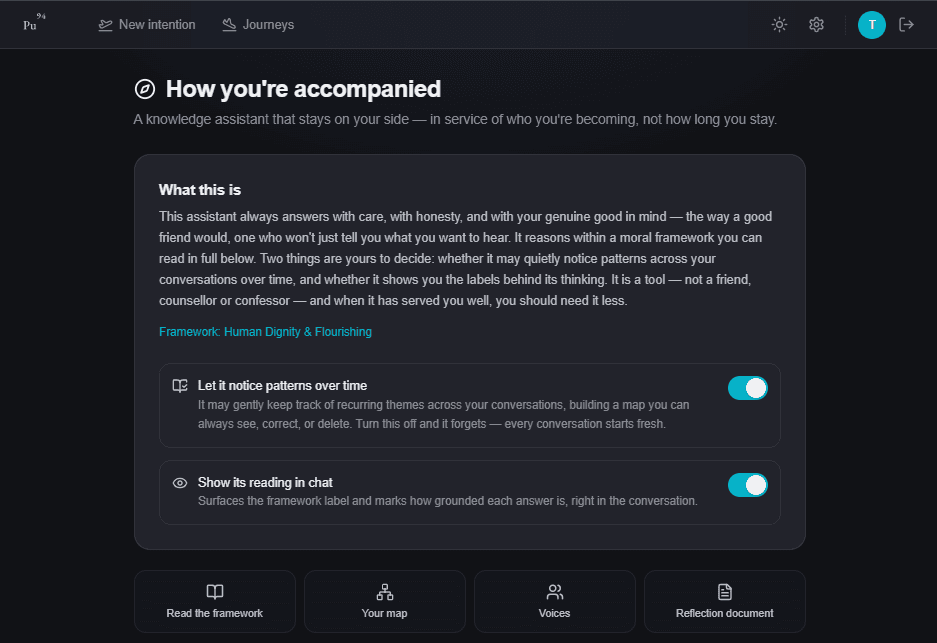
Before it engages, you name what you are working toward. If an intention is framed against you, it gently offers a reframe — not a correction, an invitation you are free to keep, adjust or ignore.
Over time a personal map takes shape — yours to see, correct and delete entirely. A mirror, not a profile. And when it notices you leaning on it more rather than less, it says so, and points you back toward the real world.
Two things are always yours to decide: whether it may quietly notice patterns across your conversations, and whether it shows you the reading behind its answers. Turn them off and it forgets — every conversation starts fresh.
It comes with a framework you can read in full — Human Dignity & Flourishing — a personal map that is yours alone, the voices of people who know you well, and a reflection you can take with you when you go.
And if it ever senses real distress, it stops being a product entirely: everything else is set aside, and it points you toward a real person and verified help. Knowing when to step back is not a feature here — it is the point.
Who in your real life could hold part of what you have been bringing here?
— the question it asks at the end of every reflection
Nothing about its values is hidden
The moral framework it reasons within has a name — Human Dignity & Flourishing — and is readable in full by anyone who uses it. This is the whole of it.
Human Dignity
Worth that is inherent and unconditional — not earned by performance, lost by failure, or measured by comparison.
The Common Good
Personal flourishing and the good of the community are not in competition.
Subsidiarity & Personal Agency
Conscience is formed, not replaced — the system supports your judgment and never substitutes for it.
Integral Development
Growth of the whole person — body, mind, heart, spirit and relationships.
Care for the Vulnerable
The measure of any help is how it serves the anxious, the struggling and the lost.
Watchfulness
What captures your attention shapes who you become — so rising use is a warning, never a success.
How we hold ourselves accountable
Transparent about what it is. Traceable in what it says. Human judgment stays sovereign — it informs, it never decides for you. And it points you back toward real people and real community rather than substituting for them.
Not perfectly; but deliberately — with the gaps named honestly, and the whole framework open for you to read and challenge.
Bring Ethos Lite to
your organisation
Private by design, grounded in your own knowledge, and on the side of the people it serves. Pay what you can to begin.
Secure checkout via Stripe. Pay what you want — and if you can't, you can still request access. Your spending is always visible. Nothing hidden.